TLDR
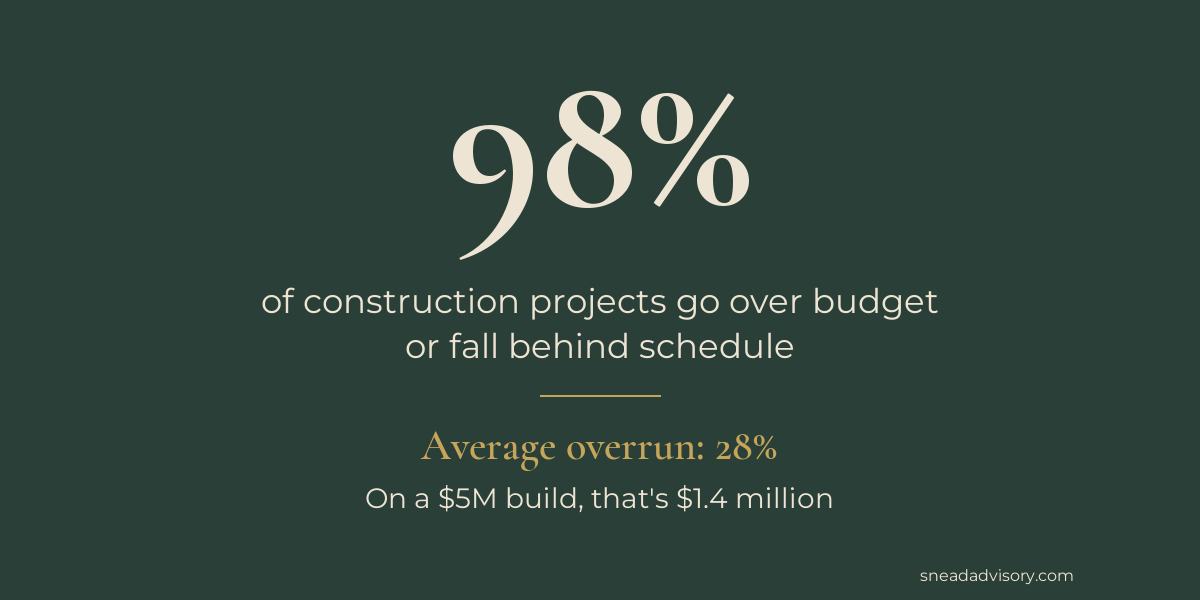
- 98% of builds go over budget. The average overrun is 28%, or $1.4M on a $5M home.
- An owner's rep reviews contracts, verifies pay apps, checks work quality, and documents everything. They work for you, not the builder.
- Owner's rep fees run 1-5% of construction cost. Documented ROI: 6.25x return on one engagement.
- Central FL permits up 18%, contractor fraud is a billion-dollar problem, and no dedicated luxury owner's rep firm exists in the Windermere/Lake Nona corridor.
An owner's representative for a custom home build is someone who works exclusively for you, the homeowner, throughout the entire construction process. They review your contracts, scrutinize every pay application and change order, verify work quality on site, and hold your builder accountable to the budget and schedule you agreed to. They are the only person on your project whose sole job is protecting your money and your interests. Not the builder's margin. Not the architect's design vision. Yours.
That might sound simple. It's not. And the fact that most homeowners have never heard of this role is exactly why construction projects go sideways as often as they do.

The Problem This Role Solves
98% of construction projects experience cost overruns or delays. The average overrun is 28% of the original budget.
On a $5 million custom home, that 28% average means $1.4 million in unexpected costs.
Those numbers are not an accident. I've spent nearly 15 years in the construction industry, from designing structural packages for custom homes to managing large-scale projects for specialty contractors. I've been on every side of the table. I've been the engineer designing the fix. I've been the project manager tracking the budget. I've been the guy in the field telling the GC that what they poured doesn't match the drawings.
The pattern is always the same. The homeowner signs a contract, trusts the builder, and checks in occasionally. Meanwhile, change orders stack up. The schedule slips. Materials get substituted. Pay applications include charges for work that isn't done yet, or isn't done right. By the time the homeowner realizes what happened, they're deep into the build with no leverage and a pile of invoices they can't verify.
An owner's representative prevents that.
What an Owner's Rep Actually Does, Phase by Phase
Before Construction Starts
This is where the most money gets saved, and most homeowners skip it entirely.
An owner's rep reviews your construction contract before you sign it. Not after. They look at payment terms, allowance structures, change order procedures, and warranty provisions. They identify the clauses that protect the builder and the ones that leave you exposed. For example, allowances set unrealistically low so the builder can show a lower contract price, knowing every upgrade will be a change order that hits your budget later.
They help establish a realistic budget based on actual Central Florida construction costs, which currently run $280 to $450+ per heated/cooled square foot for luxury builds. They set up a project schedule with real milestones, not the optimistic timeline the builder quoted to win the job.
If you haven't selected a builder yet, an owner's rep can run a competitive bidding process. One of the most common things I see: homeowners talk to one or two builders, pick the one they like best, and never get a true competitive number. That single decision can cost six figures.
During the Build
This is the core of the job. Weekly or biweekly site visits. Reviewing every pay application line by line before you write a check. Evaluating every change order to determine if the work is actually outside the original scope or if the builder is recovering margin they gave up in the bidding phase.
An owner's rep for a custom home sits in on OAC meetings (Owner, Architect, Contractor) and makes sure decisions are documented, action items are tracked, and nobody walks out of the room with a different understanding of what was agreed to.

They check that the materials showing up on site match what's in the spec book. They verify that the sub doing your tile work is the A-team the builder promised, not the B-team they swapped in because the A-team is on another job.
Change orders often receive less scrutiny than the original bid. Your initial contract went through weeks of negotiation. But a $40,000 change order during construction? That might get approved with a single signature and no backup documentation. This is where money disappears. An owner's rep makes sure every change is justified, documented, and priced fairly.
At Project Closeout
The punch list on a custom home can have hundreds of items. An owner's rep walks the entire property with a trained eye and documents every deficiency, from visible issues like trim gaps and paint touch-ups to functional problems like HVAC balancing and drainage grading.
The builder's own punch list is not enough. The builder writes that list, and they are not going to put their own deficiencies on it. An owner's rep creates an independent punch list, and that difference matters.
They verify that all contractual obligations are met before you make your final payment. They collect every close-out document: warranties, as-built drawings, equipment manuals, lien releases. They make sure you aren't signing off on a finished home that still has corrections sitting in a builder's "we'll get to it" pile. I've seen it happen.
I watched someone close to me go through a final walkthrough on a $5 million-plus home. The builder had substituted lower-grade finish materials in several rooms and delayed punch-list corrections for months. These were people who were actively involved throughout the build, and they still had to fight through the closeout process. Imagine how that goes for the homeowner who shows up once a month.
"But My Builder Has a Project Manager"
This is the most common pushback I hear. And it makes sense on the surface. The GC has a project manager. Why do you need someone else?
Because that PM works for the builder.
Their job is to deliver the project profitably for the GC. Every dollar they save goes to the builder's bottom line, not yours. They aren't reviewing change orders to protect your budget. They're reviewing them to protect theirs.
There can be several project managers on a single build: one for the GC, one for the architect, one for the engineering firm. The owner's representative is the one person whose job is to make sure all of those PMs are actually delivering for you.
Why This Matters in Central Florida Right Now
New construction permits in Central Florida jumped 18% last year. Golden Oak accounted for eight of the ten priciest home sales in 2025. New luxury communities are popping up across Windermere, Dr. Phillips, and Lake Nona.
Florida authorities have called contractor fraud "a billion-dollar problem." One Florida builder, Spencer Calvert of Pineapple Corporation, was arrested for embezzling over $15 million from clients between 2019 and 2023. His victims included a reality TV personality with a public platform, and they still got burned.
Booming demand, labor shortages, and material price swings put pressure on even honest builders. Subs get stretched thin and cut corners. Material costs spike between design and construction, and those increases show up as change orders. Timelines slip because the framing crew is juggling four other projects.
On top of that, Central Florida's hurricane building codes add another layer of complexity. HVHZ wind requirements, impact-resistant windows, and specific tie-down and roof-to-wall connection standards all need to be verified during construction, not after. An owner's rep who catches a missed wind mitigation detail during framing saves you money on insurance premiums for decades.
None of this means your builder is dishonest. But the system works against you by default, and without someone watching your side, that costs you money.
The Math
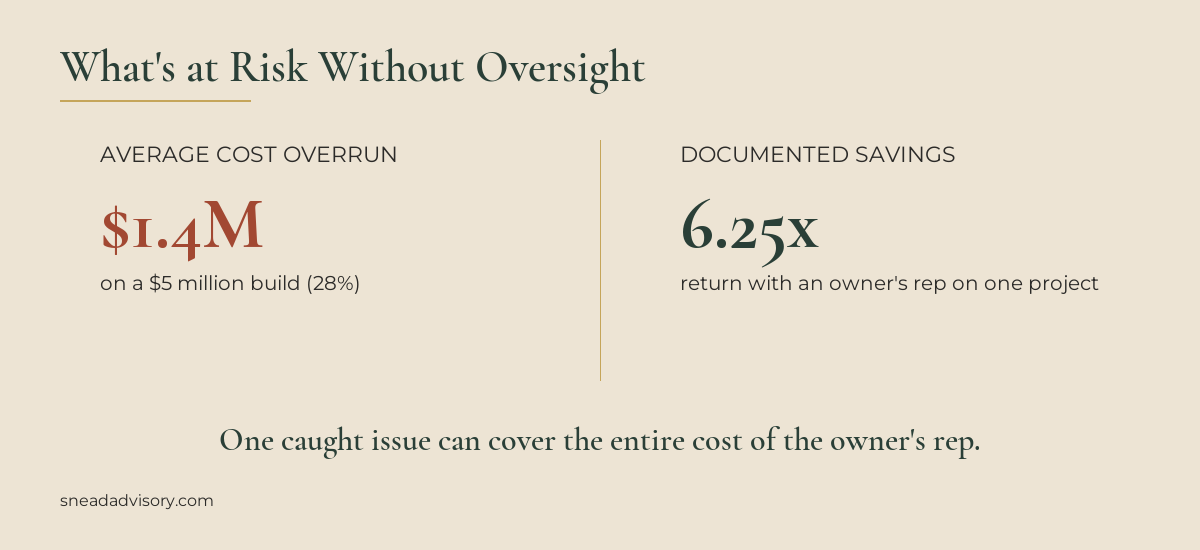
The average cost overrun on a construction project is 28%. On a $5 million build, that's $1.4 million in unexpected costs. One documented engagement produced $250,000 in savings, a 6.25x return on the owner's rep fee.
An owner's rep pays for themselves the first time they catch something. See how Snead Advisory structures engagements.
Find Out How to Protect Your Investment
Who Needs an Owner's Representative?
Not every build needs one. If you're doing a $400,000 spec home with a builder you've used three times before, you're probably fine.
But if you're building a $3 million-plus custom home and this is your first time through the process, you should have someone in your corner. Same if your career keeps you off-site most weeks, or you're building in a market you don't know.
You don't build enough houses in your life to know a good builder until after it's over. That's the whole point of having someone who already knows.
Next Step
If you're planning a custom home in Central Florida and want to understand how an owner's representative would work for your specific project, I'd like to hear about it. I'll tell you straight whether I think you need one.