TLDR
- The lowest bid is rarely the best value. A bid 15-20% below other qualified builders usually means underestimated scope, low allowances, or a plan to recover margin through change orders.
- Your builder's subcontractors do 90% of the physical work. The quality of those subs determines the quality of your home, and top subs choose which builders they work with.
- The construction contract is the most important document in your project. Most homeowners spend more time choosing kitchen tile than reviewing the contract that governs their $3M+ build.
- Six specific red flags during the selection process will tell you more about a builder than any showroom visit or marketing brochure.
Choosing a custom home builder in Windermere is the most consequential decision you'll make on your project. More than the lot. More than the architect. More than the floor plan. Your builder determines whether the next 18-24 months of your life are a smooth process or an expensive education.
I've spent nearly 15 years in construction, from designing structural packages for custom homes to managing large-scale field projects for specialty contractors. I've worked alongside builders, evaluated their work, and seen firsthand what separates the ones who deliver from the ones who don't. The difference is rarely visible in a portfolio or a showroom. It shows up in how they run a job site, how they handle problems, and how they treat your money.
If you're building a $3M+ custom home in Windermere, here's how to find the right builder and, just as important, how to spot the wrong one.
Start with the Right Pool
The Windermere market has a specific set of builders who routinely work at the $3M+ level. That matters. A builder who does excellent $800K semi-custom homes in Clermont may not have the subcontractor relationships, project management systems, or material sourcing network required for a $5M estate in Isleworth.
Your first filter should be experience at your price point. Not one project three years ago. Consistent work at or above your budget level in the last two to three years.
The best sources for qualified builders:
- Your architect. Architects work with builders daily. They know who executes their designs well and who cuts corners. If you've already hired an architect, ask them for three to five names. This is the single best referral channel for luxury builds.
- Your realtor. Experienced luxury realtors in the Windermere corridor see which builders produce homes that hold value and which ones produce warranty complaints. Agents working the Isleworth, Keene's Pointe, and Butler Chain markets have seen dozens of builds come through.
- Community-approved builder lists. If you're building in Golden Oak, Isleworth, or other gated communities with architectural review, there's often a pre-approved builder list. That list is a starting point, not a final answer.
- Past clients. Not the references the builder hands you. Those are curated. Find homeowners who built with that builder two to three years ago and ask about warranty responsiveness, budget accuracy, and communication during the hard parts of the build.
Interview at least three builders. Five is better. Request detailed line-item proposals, not just a per-square-foot number. A $/sf quote tells you almost nothing about what's actually included. I broke down why that number is misleading in a previous post.
The Bid Trap
Here's where most homeowners make their first expensive mistake: they pick the lowest number.
Competitive bidding is smart. Choosing the cheapest bid is not. When one builder comes in 15-20% below the other qualified proposals, that's not a bargain. That's a preview of how the next 18 months will go.
A low bid typically means one or more of these things:
- Underestimated scope. The builder excluded items that other bidders included. You'll pay for them later as change orders, at a higher price and with less leverage.
- Lowballed allowances. That $5,000 lighting allowance on a 6,000 SF luxury home? Not realistic. $25,000-$50,000 is closer to market for the finish level you expect. Low allowances make the contract price look competitive while guaranteeing cost overages.
- Margin recovery plan. The builder bid aggressively to win the job and plans to make up the difference through change order markup, material substitutions, or schedule acceleration charges.
The right approach: compare bids on an apples-to-apples basis. Normalize the scope. Benchmark the allowances. Understand what's included and what's not. This is exactly the kind of work an owner's representative does before you sign anything.

Your Builder Is Only as Good as Their Subs
This is the part nobody talks about, and it might be the most important factor in your decision.
Your builder is a general contractor. They manage the project. But the electricians, plumbers, HVAC technicians, trim carpenters, tile setters, and roofers who actually build your home are subcontractors. On a luxury custom home, you might have 20 or more specialty subs on the project.
The quality of your home depends on the quality of those subs. And here's the thing: the best subcontractors in Central Florida choose which builders they work with. They gravitate toward builders who pay on time, manage their projects well, and treat the field crews professionally. A builder who can't attract and retain top-tier subs will deliver an inconsistent product.
When you're evaluating a builder, ask these questions:
- Who are your primary subcontractors for electrical, plumbing, HVAC, and finish carpentry?
- How long have you worked with your current sub base?
- Do you use the same crews on every project, or do you bid out each trade per job?
A builder who has worked with the same core team for five or more years is telling you something. A builder who constantly rotates subs is telling you something too. Usually that means payment issues, management problems, or both.
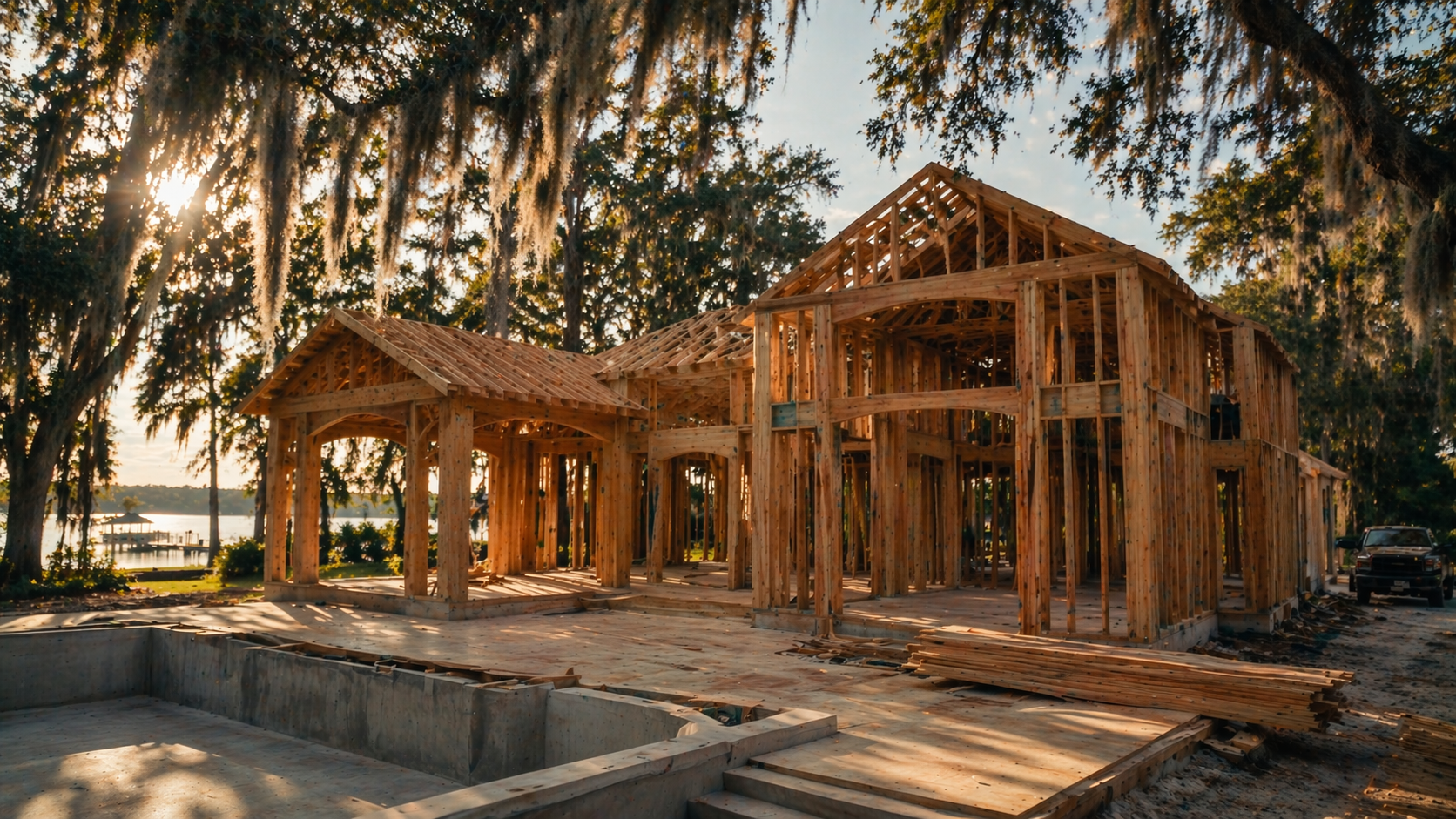
Visit an active job site. Not the one the builder shows you. Ask to see the one that's in the middle of framing or rough-in, where the real work is happening. Look at how organized the site is. Look at how the subs interact with the builder's superintendent. Is the site clean and well-organized, or is it chaotic? That job site is a preview of yours.
The Contract Matters More Than the Handshake
I cannot stress this enough: your construction contract is the most important document in the entire project. Every payment, every change order, every dispute, every warranty claim is governed by what's in that contract.
Most homeowners spend more time choosing their kitchen tile than reviewing their construction contract. That's a $3M+ mistake waiting to happen.
Three contract structures exist for custom homes, and which one your builder proposes tells you something about how they operate:
Fixed-price: The builder gives you a total number. You know the cost upfront. The builder assumes risk for overruns within the original scope. The downside: less transparency on actual costs, and the builder pads the price to cover their risk.
Cost-plus: You pay actual construction costs plus a builder fee (typically 15-25% markup). Complete transparency on every invoice. The downside: no cost ceiling, and the builder has no financial incentive to control costs since their fee is a percentage of spend.
Guaranteed maximum price (GMP): A ceiling price with shared savings if costs come in under. Combines the transparency of cost-plus with the budget protection of fixed-price. More complex to administer but increasingly common for sophisticated homeowners building in Windermere.
Beyond the contract type, specific provisions matter enormously:
- Allowances: Are they realistic for your finish level, or are they artificially low?
- Change order procedures: Is written approval required before work begins? What markup applies?
- Payment schedule: Does the schedule align with work completed, or is it front-loaded in the builder's favor?
- Material escalation clauses: With 2026 tariffs adding 5-8% to construction costs, who absorbs price increases?
- Retainage: Is 5-10% held back until substantial completion? If not, your leverage disappears.
An attorney reviews the legal language. But the construction-specific provisions, the allowances, the payment structure, the escalation clauses, require someone who understands how custom homes are actually built. That's where an owner's representative adds value before the first shovel hits dirt.

Six Red Flags That Should Stop You Cold
After nearly 15 years in this industry, these are the warning signs I've learned to watch for. Any one of them should make you pause. Two or more should make you walk.

1. Pressure to sign quickly. "This price is only good until Friday." Real builders don't create artificial urgency. Their work speaks for itself, and they have enough demand that they don't need pressure tactics.
2. Resistance to detailed line-item budgets. If a builder gives you a per-square-foot number and pushes back when you ask for a detailed breakdown, they don't want you seeing how the money is allocated. That's not a good sign.
3. No formal change order process. Change orders are where the most money moves on a custom home. A builder who handles changes verbally or with informal documentation is setting you up for disputes. Every change should be documented in writing, priced, and approved before work begins.
4. References only from in-progress clients. A builder should be willing to connect you with homeowners who completed their build one to two years ago. Those conversations reveal how the builder handles warranty work, punch-list completion, and post-construction issues. In-progress clients can only tell you about the honeymoon phase.
5. Reluctance to work with independent oversight. A builder who pushes back on you hiring an owner's representative or independent inspector is telling you they don't want someone checking their work. Good builders welcome independent oversight because it validates their quality and streamlines communication.
6. Badmouthing competitors. Confident builders talk about their own work. They don't need to tear down the competition. If your builder spends more time criticizing other firms than explaining their own process, that's a character indicator worth noting.
Verify Everything
Florida makes it straightforward to check a builder's credentials. Before you sign anything:
- License verification: Visit myfloridalicense.com and search for the builder's Certified General Contractor (CGC) or Certified Building Contractor (CBC) license. Check for active status and any disciplinary history.
- Insurance: Request certificates of General Liability ($2M+ for luxury residential) and Workers' Compensation. Verify them directly with the insurance carrier.
- Complaints: Check the Florida DBPR complaint history and Orange County records.
- Financial stability: A builder who can't pay their subs on time creates lien exposure on your property. Florida's Construction Lien Law (Chapter 713) means subcontractors and suppliers can place liens on your home if the builder doesn't pay them, even if you've already paid the builder.
That last point deserves emphasis. Under Florida law, a subcontractor who isn't paid by the builder can lien your property for the unpaid amount. Even if you wrote the builder a check that covered that sub's work. An owner's representative tracks lien exposure throughout the project and ensures lien releases are collected with every payment. I covered the importance of this in my post on whether you need an owner's representative. See how Snead Advisory structures these protections.
The Bottom Line
Choosing a custom home builder in Windermere isn't about finding the fanciest showroom or the lowest price. It's about finding a builder with the right experience at your price point, a stable subcontractor network, a fair and transparent contract structure, and a communication style that works for your project.
Interview multiple builders. Visit their job sites. Talk to past clients who are one to two years post-completion. Read the contract before you sign it, and have it reviewed by someone who understands construction, not just legal language.
If you're planning a custom home in Windermere and want help evaluating builders, reviewing contract terms, or structuring a competitive bidding process, I'd like to hear about your project. That conversation is free, and I'll tell you straight whether I think you need support or whether you're in good shape on your own.